


"Rogation" Sunday
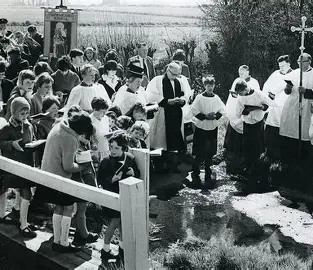
The Fifth Sunday after Easter is referred to by the subtitle 'Rogation Sunday' in the American 1928 Prayer Book as it is the Sunday before the three lesser Rogation days which are the Monday, Tuesday, and Wednesday before Ascension Day. The fact that they were once called the 'lesser' Rogation Days implies that there were major Rogation Days, and these were associate with St Mark's Day in April. This year, the two are closer together than normal thanks to a relatively early Easter. Rogation comes from the Latin word 'rogare' - to pray or make supplication - and although they were first ordered by Bishop Marmertius of Vienne in 470, and made a Gallican custom by the Council of Orleans in 511, the Rogation Days really entered the popular imagination after 536AD - the so-called 'worst year in human history' - when a major volcanic event led to a series of bad harvests. This climate event prompted not just the collapse of what remained of post-Roman Britain, but a further migration of Germanic tribesmen from the coasts of what is now northern Germany and Denmark to the island of Britain. It is not surprising then, that these days, which occur at the end of the planting season, became a popular devotion in Gaul and eventually England.
They have proved oddly enduring in the Anglican tradition, perhaps because at the very time the English Reformation was taking place, northern Europe endured another series of bad harvests. Faced with this Elizabeth I ordered the observation of the old Rogation Days ordering that parishioners go in procession beating the parish boundaries, singing psalms, especially 103 and 104, and reciting the Litany. The practice largely died out during the Commonwealth (1646-1660, ecclesiastically speaking) but vestiges hung on in some quieter places in the form of 'Beating the Bounds' until some of the old customs were revived in the late-nineteenth century. So, if you wondered why we use the Litany at Good Shepherd on Rogation Sunday here is - the rather long - answered.


Comments